
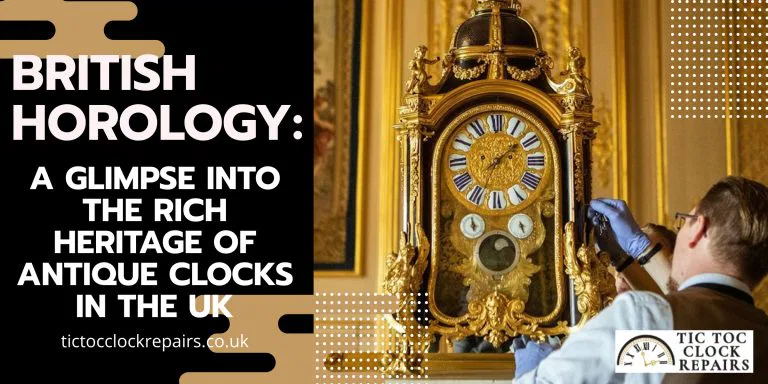
You’ve always had a fascination with history, haven’t you?
There’s something about those old-world mysteries and intriguing tales of yesteryears that never fails to captivate your imagination.
But have you ever stopped to think about the timeless objects that have stood witness to countless moments in our shared past?
I’m talking about antique clocks – the silent custodians of time.
Particularly, British horology holds an irresistible allure with its rich heritage spanning hundreds of years.
Now, imagine embarking on a journey through time – not in a fancy DeLorean or TARDIS but guided by the ticking hands of beautifully crafted British timepieces.
From their humble beginnings as primitive sundials and water clocks to the sophisticated mechanical marvels we see today, these devices tell us more than just hours and minutes; they narrate stories of human ingenuity, artistry and innovation.
So buckle up!
We’re delving deep into Britain’s illustrious clockmaking past and exploring how it has shaped the fascinating world of horology.
The Dawn of Timekeeping: A Historical Perspective
We’ve journeyed back to the very dawn of timekeeping, where the intriguing history of UK’s antique clocks first began to tick. It wasn’t all just cogs and gears, you know! The ancient Britons used sundials – simple yet ingenious devices that relied on the sun’s shadow – as their earliest form of clocks.
But don’t get it twisted; these weren’t your garden variety sundials. They were fascinating contraptions carved from large stones or even made from sticks stuck into the ground, casting a shadow on a circle marked with hours.
As we moved into the Middle Ages, things got a tad more sophisticated in blighty. The Brits started crafting mechanical clocks for monasteries and churches around 1300 AD. These early behemoths didn’t have faces like today’s clocks but struck bells on the hour – handy for calling monks to prayer or letting folks know it was time for ale at the local tavern!
Now isn’t that something? And just think, this was only the beginning of Britain’s tale in horology!
The Evolution of Timepiece Design
Delving into the evolution of timepiece design, it’s fascinating to observe how these intricate devices have transformed from simple sundials to complex mechanical marvels.
The journey started with primitive shadow clocks in ancient Egypt and gradually morphed into the sophisticated water clocks of Greece. You’ve probably heard about the hourglass, right? Well, that was a popular timekeeping device during the Middle Ages.
Then came the 14th century when everything changed – people started creating mechanical clocks! These were initially powered by weights and gears, quite a leap from their predecessors.
Here’s where things really start heating up; welcome to the era of pocket watches in Britain during the 16th century. They were like little treasures you could carry around, often made with an elegant touch of gold or silver. Imagine pulling one out at a party – talk about classy!
But as cool as they were, they had their limitations too; accuracy wasn’t exactly their strongest suit. It wasn’t until John Harrison introduced his marine chronometer in the 18th century that we saw significant improvements in precision. This invention not only revolutionized sea navigation but also set new standards for clock-making worldwide.
British horology was on fire and has been smokin’ ever since!
Noteworthy Artisans and Their Contributions
Ironically, it’s not the clockmakers who’ve been running out of time, but rather making strides in their craft with each passing second.
Britain has been home to some of the most brilliant horologists in history, whose contributions have shaped timekeeping as we know it today.
Take Thomas Tompion for instance; he’s often dubbed as the ‘Father of English Clockmaking.’ Back in the late 17th century, this guy was a trailblazer, creating clocks and watches that were renowned for their exceptional quality and precision. He even introduced new designs like the longcase clock or what you might more commonly call a grandfather clock.
And then there’s George Graham, another British artisan from the early 18th century who made significant strides in horology. You see, before quartz and digital technology came into play, maintaining accurate time was a real challenge. But thanks to Graham’s innovative thinking and tireless dedication to his craft, he developed mechanisms like the deadbeat escapement and mercury pendulum which drastically improved accuracy in mechanical clocks.
So next time you’re admiring an antique British timepiece or any clock for that matter – remember to appreciate these artisans’ immense contributions to horology – they’ve truly stood against all odds – against all ticks and stocks!
The Impact of Technological Advances on Clock Making
Now, let’s fast forward to the era of technological advancements and see how it’s completely revolutionized the craftsmanship behind timepieces.
Gone are the days when clock-making was all about meticulous handcrafting and an eye for detail. While these traits are still valued, technology has undoubtedly changed the game. You’ve got machinery that can cut gears with unprecedented precision, computer software that can predict a clock’s performance before it’s even built! It’s like stepping into a futuristic world where tradition meets innovation.
But don’t think for a moment that this diminishes the value or beauty of British horology – far from it! The integration of modern tech has injected new life into this age-old craft. Imagine 3D printing used to reproduce rare parts or laser engraving adding intricate designs on clock faces – pretty cool, right?
Even better, these advances often increase efficiency and accuracy, making our beloved antique-style clocks more reliable than ever. And rest assured, despite all these high-tech interventions, each piece still carries a slice of history and artistry that makes British horology truly unique.
So here’s to celebrating the old while embracing the new in this fascinating world of clock making!
Collecting and Preserving Historical Timepieces
As a timepiece enthusiast, you understand that collecting and preserving historical clocks isn’t just about amassing beautiful objects; it’s akin to being a guardian of history.
Imagine holding a pocket watch from the Victorian era, its intricate gears ticking away the seconds just as they did over 150 years ago – it’s like cradling a piece of time itself in your hands!
The sense of awe and reverence that arises from such experiences is truly indescribable. You’re not merely collecting clocks – you’re curating fragments of human ingenuity and technological advancement, each piece brimming with stories waiting to be told.
Now, here’s where things get interesting: maintaining these antique treasures requires more than simple dusting or occasional winding. It involves understanding the unique needs of each clock – after all, they’re old gents who need some tender loving care!
Some might need oiling using special horological oils to keep their mechanisms running smoothly while others may require professional restoration for worn-out parts.
Keep an eye out for signs of trouble like inconsistent timing or strange noises, which could indicate that your vintage buddy needs help.
Remember, they’ve been ticking faithfully for decades (if not centuries) and deserve your utmost attention and respect.
So dive into this fascinating hobby armed with knowledge and patience – believe me, your efforts will be rewarded by the silent tick-tock that echoes through the corridors of time!